
Why Does Track Lighting Enhance Artwork and Displays So Well?
2026-10-19
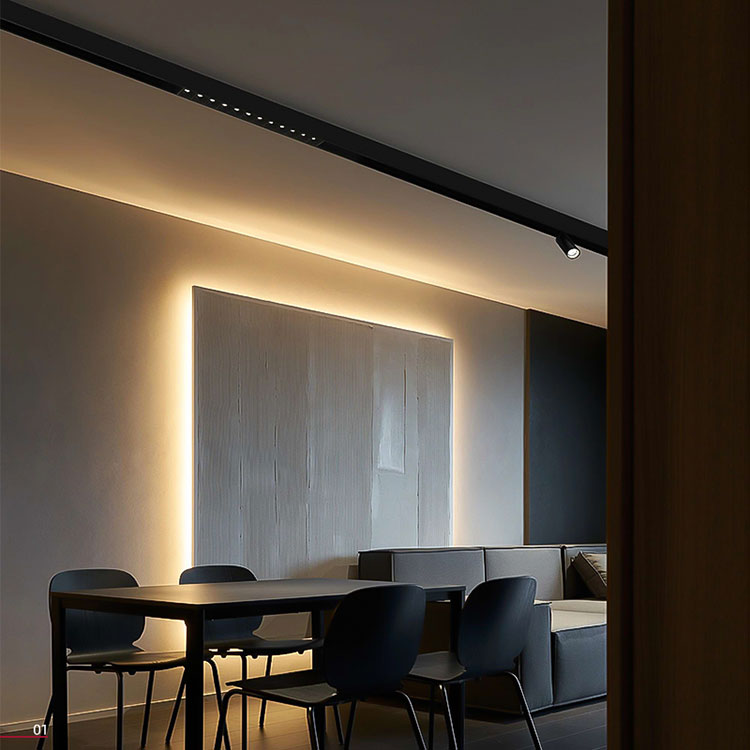
A gallery curator hangs a 19th-century oil painting on a wall. The painting is illuminated by a recessed downlight positioned 2 meters away. The curator notices that the painting looks flat. The brushwork is not visible, and the colors appear muted. The curator replaces the downlight with a Track Lighting fixture mounted on a rail 1.5 meters from the wall. The fixture is aimed at a 30-degree angle, and the beam angle is adjusted to 24 degrees. The painting is transformed. The texture of the canvas is visible, the colors are saturated, and there is no glare in the viewer's eyes. The difference is not the brightness. It is the control of the light. This guide explains why track lighting is the preferred solution for artwork and displays.
1. How Does Beam Angle Control the Visibility of Texture and Detail?
The beam angle determines the size of the light pool on the artwork. A narrow beam (15 to 24 degrees) produces a concentrated pool that highlights texture and detail. A wide beam (36 to 60 degrees) produces a broad wash that illuminates the entire surface evenly but reduces the visibility of texture. For a painting with heavy impasto, a narrow beam aimed at a grazing angle (30 to 45 degrees from the wall) creates shadows that reveal the brushwork. For a photograph or a print, a wider beam at a steeper angle (15 to 20 degrees) provides even illumination without shadows. The table below shows the recommended beam angle for different artwork types.
| Artwork type | Recommended beam angle | Aiming angle from wall | Effect |
| Oil painting (impasto) | 15 – 24° | 30 – 45° | Highlights texture and brushwork |
| Photograph or print | 24 – 36° | 15 – 20° | Even illumination, minimal shadow |
| Sculpture (3D) | 15 – 24° (two or more fixtures) | 30 – 45° from two sides | Creates depth and form |
| Textile or tapestry | 36 – 60° | 20 – 30° | Soft, even wash |
| Retail display (product) | 24 – 36° | 25 – 35° | Accent lighting with good contrast |
In our factory, we manufacture Track Lighting fixtures with interchangeable lenses that provide beam angles from 15 to 60 degrees. The lenses are made from PMMA with a high transmission rate and a sharp cut-off. This allows the curator to change the beam angle without replacing the fixture. Zhongshan Dadi Lighting Technology Co., Ltd. has been manufacturing track lighting for over 12 years.
2. Why Is Color Rendering Index Critical for Artwork?
The Color Rendering Index (CRI) measures how accurately a light source renders colors compared to natural daylight. A CRI of 100 is perfect. A CRI below 80 can cause colors to appear dull or shifted. For artwork, a CRI of 90 or higher is recommended. A CRI of 95 or higher is preferred for critical color matching. The table below shows the effect of CRI on the appearance of different colors.
| CRI | Red rendering (R9) | Blue rendering (R12) | Visual effect on artwork |
| 70 – 80 | Poor (R9 < 0) | Moderate | Colors appear muted; reds and skin tones look dull |
| 80 – 90 | Moderate (R9 20 – 50) | Good | Acceptable for general display; reds slightly muted |
| 90 – 95 | Good (R9 50 – 70) | Very good | Good color accuracy; suitable for most galleries |
| 95 – 100 | Excellent (R9 > 70) | Excellent | Excellent color accuracy; suitable for museums |
In our factory, we use LEDs with a CRI of 95 and an R9 value above 70 for our gallery-grade Track Lighting fixtures. The R9 value is particularly important for red and skin tones. A low R9 causes reds to appear brown or muted. We also offer a CRI of 90 for general display applications where cost is a consideration. Zhongshan Dadi Lighting Technology Co., Ltd. provides spectral data for each fixture so that the curator can verify the color rendering before installation.
3. How Does Glare Control Improve the Viewing Experience?
Glare is the enemy of artwork illumination. Glare occurs when the light source is visible in the viewer's field of vision or when the light reflects off the surface of the artwork. Track lighting can control glare in two ways: by shielding the light source and by controlling the direction of the light. The first is achieved with a deep reflector or a honeycomb louver. The second is achieved by aiming the fixture at a grazing angle so that the reflected light does not reach the viewer's eyes. The table below shows the glare control methods and their effectiveness.
| Glare control method | Effectiveness | Impact on light output | Typical application |
| Deep reflector (50 mm) | Good | 5 – 10% loss | General gallery lighting |
| Honeycomb louver | Excellent | 15 – 25% loss | High-glare environments |
| Snoot (tube) | Excellent | 10 – 20% loss | Precision aiming |
| Cross-baffle | Good | 10 – 15% loss | Retail displays |
| Grazing angle (30 – 45°) | Excellent | No loss | Textured artwork |
Curator's tip: The best glare control is achieved by combining a deep reflector with a grazing angle. The deep reflector hides the light source from the viewer's direct view, and the grazing angle prevents the reflected light from reaching the viewer's eyes. In our factory, we recommend a 50 mm deep reflector for most gallery applications. For high-end museums, we recommend a honeycomb louver combined with a snoot for precise aiming.
4. What Color Temperature Suits Different Artwork and Display Contexts?
The color temperature of the light affects the mood and the perceived color of the artwork. Warm white (2700K to 3000K) creates a cozy, intimate atmosphere and enhances the warmth of oil paintings and wood sculptures. Neutral white (3500K to 4000K) provides a balanced, natural appearance and is suitable for photographs and modern art. Cool white (5000K to 6000K) creates a crisp, clinical look and is used for retail displays and technical exhibits. The table below shows the recommended color temperature for different applications.
| Application | Recommended color temperature | Effect |
| Oil paintings (classical) | 2700 – 3000K | Warm, intimate; enhances reds and yellows |
| Modern art (acrylic, mixed media) | 3500 – 4000K | Neutral; accurate color representation |
| Photographs and prints | 4000 – 4500K | Balanced; avoids color cast |
| Sculpture (stone, bronze) | 3000 – 3500K | Enhances form and texture |
| Retail display (fashion) | 3500 – 4000K | Crisp; accurate fabric colors |
| Jewelry display | 4000 – 5000K | Bright; enhances sparkle |
In our factory, we manufacture Track Lighting fixtures with tunable white LEDs that allow the curator to adjust the color temperature from 2700K to 5000K. This is useful for exhibitions that combine different types of artwork. The tunable white feature also allows the curator to adjust the lighting for different times of day or for different exhibition themes. Dadi provides a color temperature tuning guide with each tunable white fixture.
Frequently Asked Questions About Track Lighting for Artwork and Displays
Summary for Curators and Lighting Designers
Track Lighting enhances artwork and displays by providing precise control over beam angle, color rendering, glare, and color temperature. The beam angle determines the visibility of texture and detail. The CRI determines the accuracy of color reproduction. The glare control determines the viewing comfort. The color temperature determines the mood and the perceived color. By selecting the right fixture and positioning it correctly, the curator can transform the appearance of the artwork without changing the artwork itself. Zhongshan Dadi Lighting Technology Co., Ltd. has been manufacturing track lighting for over 12 years and provides full photometric and spectral data for our products.
Zhongshan Dadi Lighting Technology Co., Ltd. manufactures Track Lighting fixtures with interchangeable lenses (15 to 60 degrees), CRI of 95 (R9 > 70), deep reflectors, and tunable white LEDs (2700K to 5000K). We provide lighting layout services and photometric simulations for galleries and museums.