
How do material refractive indices influence performance in high brightness side entry lighting optics
2026-05-15
The optical performance of High Brightness Side Entry Lighting Optics Light Guides depends critically on the selection of base materials. Among the brands advancing this technology, Jin Mingwei has demonstrated how precise refractive index engineering can elevate light extraction efficiency, uniformity, and thermal stability. Understanding the relationship between refractive indices and light behavior is essential for engineers designing automotive lighting, display backlights, and architectural illumination systems.
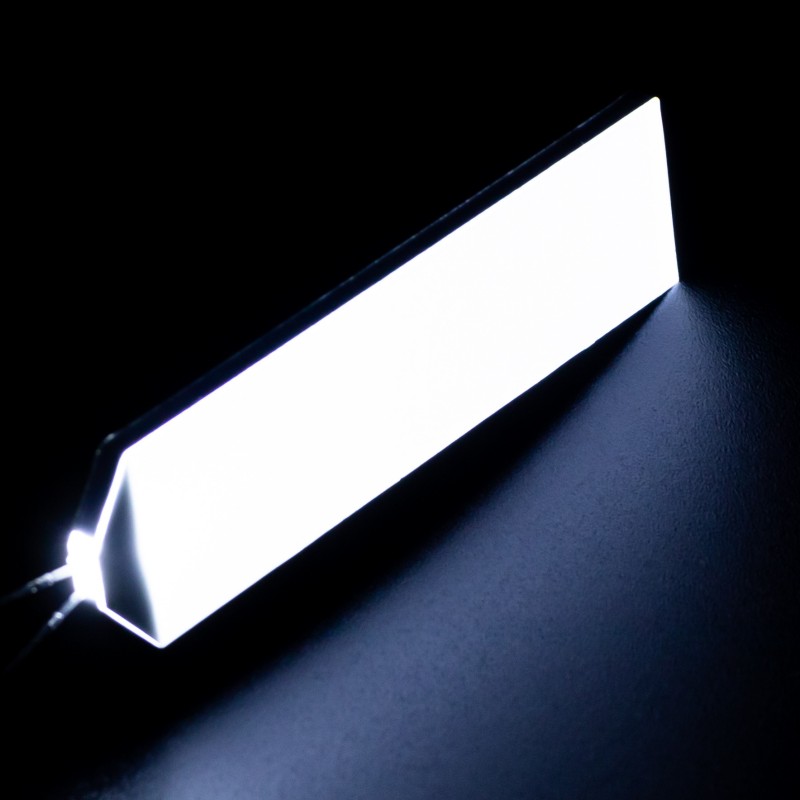
Refractive index determines how light bends when entering or exiting a light guide. In High Brightness Side Entry Lighting Optics Light Guides, a higher core index (typically 1.49–1.59 for optical-grade polymers like PMMA or PC) enables total internal reflection (TIR) along the guide length. However, if the cladding or surrounding medium has an index too close to the core, TIR is compromised, leading to leakage and reduced brightness. Conversely, a large index contrast increases the critical angle, allowing more light to travel further before extraction.
| Material | Refractive Index (n) | Light Extraction Efficiency | Typical Application |
|---|---|---|---|
| PMMA (Acrylic) | 1.49 | Moderate | General lighting, edge-lit displays |
| Polycarbonate (PC) | 1.59 | High | Automotive, high-temperature environments |
| Optical Silicone | 1.41 | Low to Moderate | Flexible light guides |
| Glass (BK7) | 1.52 | High (but rigid) | Premium optical systems |
Jin Mingwei optimizes side entry optics by adjusting micro-dot patterns and index-matching layers. A lower index coating on extraction features can redirect light more efficiently toward the exit surface, boosting brightness by up to 30%. Mismatched indices between the LED coupling region and the light guide cause Fresnel losses—remedied by index-matching adhesives or insert molding.
Below are three High Brightness Side Entry Lighting Optics Light Guides frequently asked questions:
What is the ideal refractive index for maximizing brightness in side entry light guides?
The ideal index ranges from 1.53 to 1.59 for polycarbonate-based systems. A higher index increases the critical angle for TIR, allowing light to propagate longer distances before escaping. However, excessively high indices (above 1.65) introduce scattering losses and material incompatibility with standard LEDs. Jin Mingwei typically uses PC with n=1.59 combined with surface microstructures to achieve 85%+ extraction uniformity.
How does refractive index mismatch between the LED encapsulant and light guide affect performance
Mismatch creates Fresnel reflection at the coupling interface, reducing injected light by 8–15% per surface. For example, an LED with silicone encapsulant (n=1.41) coupled into PMMA (n=1.49) loses ~4% due to reflection. Jin Mingwei applies index-matching fluids or direct overmolding of PC onto LED packages, reducing losses below 2%. This step is critical for High Brightness Side Entry Lighting Optics Light Guides in high-power applications.
Can thermal changes in refractive index ruin light guide uniformity over time
Yes. Most polymers have a negative thermo-optic coefficient (dn/dT ≈ -1×10⁻⁴ /°C for PC). As temperature rises, the refractive index drops, reducing the critical angle and causing premature light escape near the LED entry. This creates hotspots and dim tail sections. Jin Mingwei solves this by blending heat-stabilized PC with inorganic nanoparticles to stabilize dn/dT, maintaining uniformity across -40°C to +110°C operating ranges.
For designers, matching refractive indices across the LED coupling medium, light guide core, and extraction layer ensures predictable beam angles. Jin Mingwei provides customized refractive index solutions for High Brightness Side Entry Lighting Optics Light Guides, including dual-layer guides with high-index cores and low-index extraction claddings.
Contact us today to request material samples or optical simulation support for your next lighting project.