
1. Common Sports Lighting Challenges
Sports facilities have lighting requirements that differ from ordinary outdoor spaces. Players need to follow fast-moving balls, recognize teammates, judge distances, and react quickly. Spectators need clear visibility, while cameras may require consistent illumination and suitable color reproduction.
When lighting is poorly planned, a facility may experience dark corners, excessive brightness in the players' field of view, uneven illumination, high electricity bills, or frequent maintenance interruptions. Simply installing more powerful fixtures does not necessarily solve these problems.
Uneven Illumination
Bright areas beside dark zones can make it harder for athletes to follow play and adjust their vision.
Glare and Visual Discomfort
Incorrect aiming or unsuitable optics may direct excessive light toward players, spectators, neighbors, or drivers.
High Operating Costs
Inefficient equipment, unnecessary operating hours, and poor lighting controls can increase electricity expenses.
Weather and Maintenance
Outdoor fixtures must withstand rain, dust, temperature changes, and wind exposure while remaining accessible for service.
A well-designed high power LED sports lighting system addresses these challenges through coordinated fixture selection, optical design, installation planning, electrical engineering, and ongoing maintenance.
2. How High Power LED Sports Lights Work
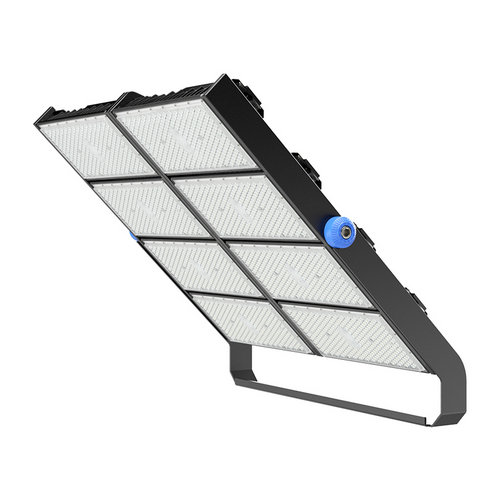
A high power LED sports light uses light-emitting diodes to convert electrical energy into visible light. The fixture combines LED modules, an electrical driver, thermal management components, optical elements, and a protective housing to deliver light to the playing area.
Step 1: Electrical Power Reaches the LED Driver
The driver regulates the electrical supply delivered to the LEDs. A suitable driver helps maintain stable operation within the specified input voltage and temperature range. Driver quality can affect efficiency, reliability, dimming compatibility, and resistance to electrical disturbances.
Step 2: LED Chips Produce Light
When current passes through the LED semiconductor material, the device emits visible light. The quantity of light produced depends on the LED package, current, temperature, optical losses, and overall fixture design. Higher electrical power alone does not guarantee higher useful light output.
Step 3: Optical Components Direct the Beam
Lenses and reflectors shape the light distribution. Sports lighting commonly requires controlled beam patterns that place light on the playing surface while limiting spill beyond the venue. Different beam angles and optical distributions can help accommodate various mounting heights and field dimensions.
Step 4: The Thermal System Removes Heat
LEDs and electronic components generate heat during operation. Heat sinks and other thermal design features transfer that heat away from sensitive components. Good thermal management helps maintain light output, supports driver reliability, and reduces the risk of premature component degradation.
Step 5: The Fixture Illuminates the Playing Surface
When multiple fixtures are correctly positioned and aimed, their light distributions combine to illuminate the court or field. The final result depends on mounting locations, fixture output, beam selection, aiming angles, surface reflectance, and the interaction between overlapping beams.
3. Key Benefits of High Power LED Sports Lighting
3.1 Strong Light Output for Large Areas
High-power fixtures can provide substantial light output for outdoor sports facilities, especially when mounted on tall poles or stadium structures. Their suitability depends on the required illuminance, installation geometry, and optical distribution rather than wattage alone.
3.2 Improved Energy Management
LED technology can offer better energy efficiency than many older lighting technologies when compared under equivalent lighting conditions. Actual savings depend on the existing installation, fixture efficacy, operating schedule, controls, and the amount of light required by the activity.
3.3 Instant-On Operation
LED sports lights generally reach useful illumination quickly after being switched on. This supports flexible operating schedules for training, community events, and recreational facilities. The behavior of any dimming or control system should still be confirmed for the selected fixture.
3.4 Flexible Light Distribution
Different beam options help lighting designers direct light toward particular zones of a playing area. Correct optics can reduce wasted light, improve uniformity, and limit unwanted illumination outside the venue.
3.5 Potentially Lower Maintenance Requirements
Quality LED fixtures can reduce the frequency of lamp replacement compared with some traditional systems. However, long-term reliability also depends on the driver, thermal design, seals, connectors, installation quality, and operating environment.
3.6 Better Control of Lighting Operations
Depending on the selected model, dimming and lighting control options can help operators adjust illumination for training, casual recreation, cleaning, or events. Controls should be matched to the electrical and communication interfaces supported by the fixture.
4. Applications Across Sports Facilities
Outdoor Stadiums and Football Fields
Large playing areas require coordinated lighting across the entire field. Designers must consider mounting height, pole positions, beam distribution, uniformity, glare, and the viewing directions of athletes and spectators. Facilities used for broadcast events may have additional requirements for color quality and camera performance.
Tennis Courts
Tennis players need to track a small, fast-moving ball against different backgrounds. Lighting should provide clear visibility throughout the court while limiting glare from fixtures in common serving and rallying directions. The number of fixtures and their aiming angles should be determined by a lighting calculation.
Basketball Courts
Basketball involves rapid movement, vertical jumps, and frequent changes in viewing direction. Uniform illumination and glare control are important for players following the ball near the ceiling or above the basket. Indoor and outdoor courts may require different fixture and environmental specifications.
Training Grounds and Community Sports Centers
Schools, clubs, and recreational facilities often need a practical balance between performance, energy consumption, and budget. A carefully planned LED system can provide the necessary visibility without automatically designing for the highest professional competition level.
Multi-Purpose Sports Venues
Facilities hosting several sports must accommodate different field layouts, operating schedules, and lighting requirements. Adjustable controls and suitable beam distributions may help operators use the same facility efficiently, provided each activity's illumination requirements are met.
Racetracks and Other Large Outdoor Areas
Racetracks and large event spaces may require long-throw illumination, careful glare management, and robust weather protection. The lighting design must account for the direction of travel, viewing distances, mounting structures, and applicable safety requirements.
5. Technical Specifications That Matter
Understanding technical specifications helps purchasers compare fixtures on a consistent basis. Always request a product datasheet and, for larger projects, photometric files and a lighting calculation based on the actual site layout.
| Specification | What It Means | Why It Matters |
|---|---|---|
| Rated power (W) | The electrical power consumed under specified conditions. | Helps estimate electrical demand and operating costs, but does not independently determine brightness. |
| Luminous flux (lm) | The total visible light output from the fixture. | Provides a useful output measure when comparing suitable products. |
| Luminous efficacy (lm/W) | The amount of luminous flux produced per watt consumed. | Helps evaluate energy efficiency alongside actual lighting performance. |
| Illuminance (lux) | The light falling on a surface. | Used to assess whether the playing area receives adequate illumination. |
| Uniformity | How evenly light is distributed across the target area. | Helps prevent excessively bright and dark zones. |
| Beam angle and distribution | How the fixture directs its light. | Affects coverage, mounting requirements, spill light, and overlap between fixtures. |
| Color rendering | How accurately colors appear under the light. | Relevant to visual comfort, color recognition, and certain broadcast applications. |
| Ingress protection (IP) | The degree of protection against dust and water under defined test conditions. | Helps establish suitability for outdoor exposure and cleaning conditions. |
| Surge protection | Protection against specified transient electrical disturbances. | Important for outdoor installations exposed to electrical surges. |
| Operating temperature | The environmental temperature range supported by the fixture. | Influences reliability in hot, cold, and demanding outdoor environments. |
Why Wattage Is Not Enough
Two fixtures with the same rated wattage may deliver different luminous flux, beam patterns, and on-field illuminance. A fixture with a suitable optical system can direct a larger proportion of its light onto the playing surface, while a poorly matched beam may waste light beyond the target area.
For reliable comparisons, evaluate the complete technical specification, photometric performance, warranty conditions, and suitability for the intended mounting arrangement.
6. How to Choose the Right High Power LED Sports Light
Choosing a sports light begins with the requirements of the venue rather than a preferred wattage. The following process helps buyers reduce the risk of insufficient illumination, unnecessary expenditure, and expensive redesigns.
Step 1: Define the Sport and Usage Level
Identify the activity, playing area, expected operating hours, and whether the facility is used for casual recreation, regular training, competitive matches, or televised events. Different activities and competition levels may have different illumination and uniformity requirements.
Step 2: Measure the Playing Area
Record the court or field dimensions, pole locations, mounting heights, surrounding buildings, and nearby residential areas. These details help determine the appropriate fixture quantity, optical distribution, and aiming positions.
Step 3: Establish the Required Lighting Levels
Determine the target maintained illuminance and uniformity from the relevant sports standards, governing body guidance, project specification, and local regulations. Consider glare, vertical illumination, color quality, and broadcast needs where applicable.
Step 4: Review Photometric Data
Ask for the fixture's photometric file, such as an IES or LDT file when available. A lighting designer can use this information to model the distribution of light across the venue and evaluate different mounting positions and beam options.
Step 5: Check Electrical and Environmental Requirements
Confirm input voltage, frequency, driver specifications, surge protection, grounding, enclosure protection, and operating temperature. For outdoor installations, consider wind exposure, rain, dust, corrosion, and access for maintenance.
Step 6: Calculate Lifetime Operating Costs
Compare initial purchase cost with expected electricity use, maintenance, access equipment, component replacement, and warranty coverage. The lowest upfront price may not deliver the lowest total cost over the intended service period.
Step 7: Confirm Installation and Support
Review mounting hardware, fixture weight, aiming adjustment, cable entry, service access, and technical support. For large installations, use qualified electrical professionals and obtain a lighting layout before purchasing the full quantity.
7. Energy Efficiency and Operating Costs
Energy consumption is an important consideration for sports facilities that operate several hours each evening. LED technology can reduce electricity use when a new system delivers the required lighting performance with less power than the previous installation.
Calculate Energy Consumption
A basic estimate can be made using the total connected load and operating hours:
For example, a lighting system with a total input load of 10 kW operating for 5 hours consumes approximately 50 kWh, excluding other equipment and any additional losses not included in the stated load.
To compare two systems fairly, ensure that both satisfy the same target illuminance, uniformity, and other performance requirements. A lower-power system is not an improvement if it leaves the playing surface inadequately illuminated.
Use Lighting Controls Where Appropriate
Separate lighting settings for training, recreation, and full competition may help reduce unnecessary energy consumption. Dimming should only be used when supported by the selected driver and when the resulting illumination remains appropriate for the activity.
Look Beyond the Purchase Price
Consider the cost of electricity, maintenance labor, access equipment, replacement drivers, and possible downtime. A reliable fixture with suitable optical performance and thermal management can provide better long-term value than a product selected on initial price alone.
8. Installation and Lighting Layout
Even a high-quality sports light may deliver poor results when installed at an unsuitable height or aimed incorrectly. Lighting layout and installation quality are essential to achieving the planned performance.
Position Fixtures Carefully
Pole locations and mounting heights affect beam overlap, uniformity, glare, and spill light. The layout should be calculated for the actual venue instead of copied from a different field or court with different dimensions.
Control Glare and Spill Light
Fixtures should be aimed to illuminate the playing area without unnecessarily directing light toward players' eyes, spectators, nearby homes, or roads. Shielding, optical selection, mounting geometry, and aiming angles can all influence the result.
Use Qualified Installation Personnel
Electrical connections, mounting hardware, grounding, and structural supports should be installed according to the manufacturer's instructions and applicable regulations. Elevated fixtures must be secured for the relevant wind and mechanical loads.
Commission the System After Installation
After installation, verify fixture aiming, controls, electrical operation, and illumination across the playing surface. Measurements at representative grid points can help establish whether the system meets the specified maintained lighting objectives and identify areas requiring adjustment.
Prepare for Future Maintenance
Ensure that technicians can access fixtures safely and that replacement components remain identifiable. Document the installation layout, driver details, control settings, and maintenance schedule to simplify future servicing.
9. Maintenance and Troubleshooting
Regular inspection helps preserve lighting performance and reduce unexpected downtime. Maintenance intervals should reflect the fixture manufacturer's guidance, operating environment, and local safety requirements.
Recommended Maintenance Checklist
- Inspect lenses and protective covers for dirt, damage, discoloration, or moisture.
- Check mounting brackets, fasteners, and structural supports for signs of loosening or corrosion.
- Inspect electrical connections, cable entries, seals, and grounding arrangements.
- Check whether the fixture's heat-dissipation surfaces are obstructed by dirt or debris.
- Verify the operation of drivers, dimming controls, timers, and communication interfaces where fitted.
- Compare lighting performance with the commissioning baseline to identify unexpected changes.
- Record failures, maintenance work, component replacements, and inspection results.
Common Problems and Possible Solutions
| Problem | Possible Cause | Recommended Action |
|---|---|---|
| Fixture does not turn on | Power supply issue, driver fault, wiring problem, or control setting. | Have a qualified technician isolate the circuit and check the electrical supply and driver. |
| Light output appears reduced | Dirty optics, thermal stress, aging components, or an electrical issue. | Inspect the fixture and compare its performance with the original baseline. |
| Uneven playing surface illumination | Incorrect aiming, failed fixtures, or an unsuitable layout. | Check fixture operation and verify the lighting distribution through measurements. |
| Visible flickering | Driver malfunction, unstable supply, dimmer incompatibility, or loose connections. | Inspect the supply, driver, and control system according to the manufacturer's procedures. |
| Moisture inside the fixture | Damaged seals, cable-entry problems, or enclosure damage. | Disconnect power safely and arrange inspection and repair before returning the fixture to service. |
| Repeated component failures | Excessive temperature, surges, unsuitable operating conditions, or installation issues. | Review the environmental conditions, electrical protection, thermal performance, and installation quality. |
Outdoor sports lighting systems often involve elevated equipment and potentially hazardous electrical circuits. Repairs should be carried out by qualified personnel using appropriate isolation procedures and safe access equipment. Do not open or service energized fixtures unless the specific procedure and applicable safety requirements explicitly permit it.
10. High Power LED Sports Lights from LedOrientalight
Choosing a suitable sports lighting supplier can help project owners evaluate fixture specifications, optical options, installation requirements, and long-term operating considerations. LedOrientalight is a lighting manufacturer and supplier offering LED sports lights and other lighting products for different application scenarios.
The company's High Power LED Sports Light range includes listed models with different rated power options. The appropriate model depends on the size and layout of the venue, required illumination, mounting height, beam distribution, and project budget.
What to Discuss with Your Supplier
- Available rated power options and the corresponding fixture specifications.
- Luminous flux, efficacy, and photometric files for lighting calculations.
- Beam angle options and recommendations for the intended mounting height.
- Color temperature, color rendering, and flicker performance where relevant.
- Driver specifications, dimming compatibility, and surge protection.
- Ingress protection, operating temperature, and other environmental requirements.
- Mounting accessories, warranty terms, technical support, and replacement components.
For a more reliable quotation, provide the venue dimensions, pole arrangement, target lighting level, operating schedule, local voltage requirements, and any competition or broadcast requirements. A suitable lighting calculation can help establish the fixture quantity, distribution, and aiming strategy before the order is finalized.
Visit the High Power LED Sports Light product page to review the available range and submit an inquiry about your project.
11. Frequently Asked Questions
1. What is a high power LED sports light?
A high power LED sports light is a lighting fixture designed to deliver substantial illumination for sports courts, fields, stadiums, and other athletic venues. Its suitability depends on its light output, optics, thermal design, electrical characteristics, and intended installation.
2. How do I calculate the number of sports lights required?
The required quantity depends on the playing area's dimensions, target illuminance, fixture output, beam distribution, mounting height, and lighting uniformity. A photometric calculation using the actual site layout is more reliable than estimating from wattage alone.
3. Does higher wattage always mean brighter sports lighting?
No. Wattage measures electrical power consumption, not the amount of useful light reaching the playing surface. Luminous flux, fixture efficacy, optical distribution, installation geometry, and aiming all influence the final result.
4. What beam angle is suitable for a sports field?
The suitable beam distribution depends on the field dimensions, pole locations, mounting height, and desired light distribution. Narrower beams may help direct light over longer distances, while wider distributions may suit other mounting arrangements. A lighting calculation should determine the appropriate choice.
5. Are high power LED sports lights suitable for outdoor use?
Models designed for outdoor installation can be suitable when their ingress protection, temperature range, corrosion resistance, electrical protection, and mounting arrangements match the environment. Always verify the specifications of the particular model.
6. How can sports lighting reduce electricity costs?
Energy savings can come from efficient fixtures, appropriate beam distribution, well-planned operating schedules, and compatible dimming or control systems. The system must still meet the venue's required lighting performance.
7. Why is lighting uniformity important for sports?
Uniformity helps reduce abrupt differences between bright and dark areas. This supports more consistent visual conditions for players and spectators and can improve the visibility of moving objects across the playing surface.
8. What is the purpose of thermal management in LED sports lights?
Thermal management removes heat from LEDs and electronic components. Effective heat dissipation helps maintain performance and supports the long-term reliability of the fixture under its specified operating conditions.
9. How often should LED sports lights be maintained?
The maintenance schedule depends on the product specifications, environmental exposure, operating hours, and installation conditions. Routine inspections should cover optics, seals, mounting hardware, electrical connections, and changes in light output.
10. What information is needed to request a sports lighting quotation?
Provide the venue dimensions, sport type, mounting heights, pole locations, target lighting level, operating schedule, input voltage, and environmental requirements. If available, include a site plan or existing lighting layout to help the supplier assess the project.
Conclusion: Plan Sports Lighting Around Performance
A high power LED sports light can be an effective solution for sports facilities that need reliable illumination, controlled light distribution, and manageable operating costs. However, successful lighting depends on matching the fixture to the venue rather than selecting products based on wattage alone.
By evaluating illuminance, uniformity, glare, optical performance, thermal management, environmental protection, and maintenance requirements, buyers can make better-informed decisions. A professional lighting calculation and a clear understanding of the site's requirements help reduce installation risks and support consistent performance over time.
Looking for a High Power LED Sports Light for Your Project?
Explore the sports lighting range from LedOrientalight and identify a suitable solution for your court, training ground, stadium, or outdoor sports facility.
Whether you are planning a new installation or upgrading an existing lighting system, contact us to discuss your project requirements, request product specifications, and learn more about available high power LED sports lighting options.
Explore High Power LED Sports Lights | Contact LedOrientalight